
 Skip to content
 If you’re planning to build in Northern Georgia, here’s the truth: Yes, you almost always need land clearing. But here’s what most people get wrong – it’s not just about cutting down trees.
In places like Blue Ridge, Ellijay, and Dahlonega, you’re dealing with thick forests, steep hills, and red clay soil. This means clearing land is more complicated than in flat areas. You can’t just remove trees and call it done. You need to think about water runoff, erosion, and keeping your property stable.
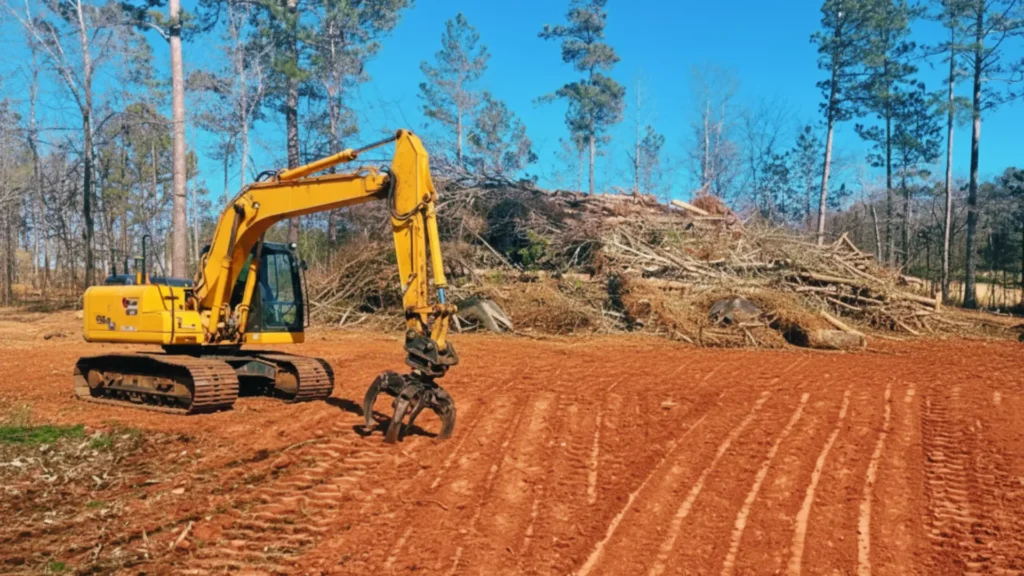
In flat subdivisions, developers often clear-cut everything. But in the North Georgia mountains, that’s usually the wrong move. So, Clear Cutting vs. Selective Clearing gives you perfect data on it –
| Aspect | Clear Cutting | Selective Clearing (The Smart Choice) |
| What is removed | Every tree and plant on the lot | Only trees where the house sits plus a 15–20 ft buffer |
| Upfront cost | Lower cost per tree | Higher cost per tree |
| Long-term cost | Higher due to erosion repairs and landscaping | Lower due to reduced erosion control and landscaping needs |
| Impact on soil | Exposes red clay to heavy Georgia rain, causing washouts | Tree roots remain to naturally stabilize steep soil |
| Erosion risk | Very high | Low |
| Property appearance | Bare, subdivision-like lot | Natural “cabin in the woods” look |
| Privacy | Little to none | High, trees remain for screening |
| Suitability for mountain land | Poor choice | Ideal choice |
Break these rules, and you could face fines or stop-work orders that delay your entire build.
Georgia law says you can’t disturb vegetation near streams.
The penalty for cutting trees in these zones is serious.
Some North Georgia counties (like Gilmer and Fannin) have mountain-building rules. On high elevations (around 2,200+ ft) or steep slopes (25%+), you may be limited to clearing only 50% of vegetation to prevent landslides and protect mountain views.
Clearing removes trees, but grubbing removes the stumps. In North Georgia’s red clay, stumps don’t rot—they linger and can cause sinkholes. Any stumps under the house must be removed. Grubbing in rocky clay is slow, hard on equipment, and can take 30–50% of your clearing budget.
Read More: Case Study: Efficient Mass Grading Strategy for Multi-Lot Developments in GA
Yes, you need land clearing before building in Northern Georgia. At Bucktown Grading and Construction LLC we specialize in exactly this type of mountain terrain. Based in North Georgia, our team works daily on steep slopes, red clay soil, and heavily wooded lots in areas like Blue Ridge, Ellijay, and Dahlonega. We don’t treat mountain land like flat subdivision property—because it isn’t.

Before bringing in bulldozers, use forestry mulching to grind brush and small trees into mulch. This reveals the natural shape of the land without stripping topsoil. The mulch also helps control erosion while you plan. Expect to clear about1–2 acres per day at roughly$1,500–$2,500.
Once you know where Land Clearing or The home site will be, most counties require a permit if you disturb more than one acre. Silt fencing must be installed along downhill edges before heavy equipment arrives to prevent sediment from reaching streams.
On sloped lots, an excavator cuts into the hillside to create a level building pad, using the removed soil as fill on the downhill side. That fill must be compacted correctly – skipping this step can lead to foundation failure later.
Georgia has become one of the top states for new home construction, especially in the northern counties. People are moving here for the mountain views, lower cost of living compared to nearby states, and the chance to own land.
But building a new home in Georgia – especially in the mountains – is different from other places. You’re not dealing with flat, easy lots. You’re working with elevation changes, rocky soil, and weather that can shut down work for days at a time on Land Clearing.
Most builders will tell you 6-8 months from breaking ground to move-in. In Northern Georgia mountains, plan for 8-12 months, maybe longer.
Why the delay of Land Clearing? Weather is the biggest factor. Heavy rain stops excavation and concrete work. Winter freezes can delay foundation curing. Summer heat affects certain materials. Plus, if you’re on a remote mountain lot, getting materials delivered takes longer.
Building costs in Georgia vary widely based on location and finishes. As of 2025-2026, expect these rough numbers:
That land clearing, grading, and foundation work we talked about? It can add $30,000 to $80,000 or more to your budget compared to flat land building or Land Clearing.
A builder who mostly works on flat subdivision lots won’t know how to handle a 15-degree slope or red clay soil. You’ll end up with problems and delays on Land Clearing.
Building Permit
Land Disturbance Permit
Septic Permit
Well Permit
Driveway Permit
Read More: The Land Grading Regulations and Permits in Georgia: The Complete Guide
Each permit requires inspections at different stages. Your builder should handle scheduling these, but you’re responsible if they don’t. A failed inspection can stop all work until issues are fixed. Plan for at least 10-15% over your estimated budget for unexpected costs.
Good builders will update you regularly. If yours goes silent for more than a week, that’s a red flag.
Spring (March-May): Best time to start excavation and foundation work. The weather is mild and dry enough to work most days.
Summer (June-August): Afternoon thunderstorms can delay exterior work. Heat makes concrete curing easier but is tough on workers, which can slow progress.
Fall (September-November): Another good building window. Cooler temperatures help workers stay productive.
Winter (December-February): Mountain areas can get ice and snow that shut down sites for days. Concrete work is risky when temperatures drop below freezing at night.
Make a punch list of anything that needs fixing on Land Clearing. Don’t close until major items are completed. Small cosmetic issues can be fixed after closing, but structural or system problems need to be addressed immediately
Read More: Understanding Erosion Control in Georgia Construction Projects
If you want a Land Clearing custom home with mountain views and land of your own, Georgia offers incredible value compared to states like North Carolina, Tennessee, or Virginia. You get more Land Clearing for your money and lower property taxes. But you need to go in with realistic expectations. Building in Northern Georgia takes longer and costs more than building on flat land. The process has more steps, more permits, and more potential delays on Land Clearing.


