
 Skip to content
 That soggy backyard isn’t your fault — but it is your problem to fix.
After every rainstorm, you walk outside and find the same mess: standing puddles, squishy grass, and muddy patches that take days to dry out. You’ve tried fixing it. Nothing works. The real culprit is hiding just a few inches underground — and most homeowners never even know it’s there.
This is the hardpan soil problem. And in North Georgia, it’s everywhere. Contact Bucktown Grading and Construction today for a free estimate
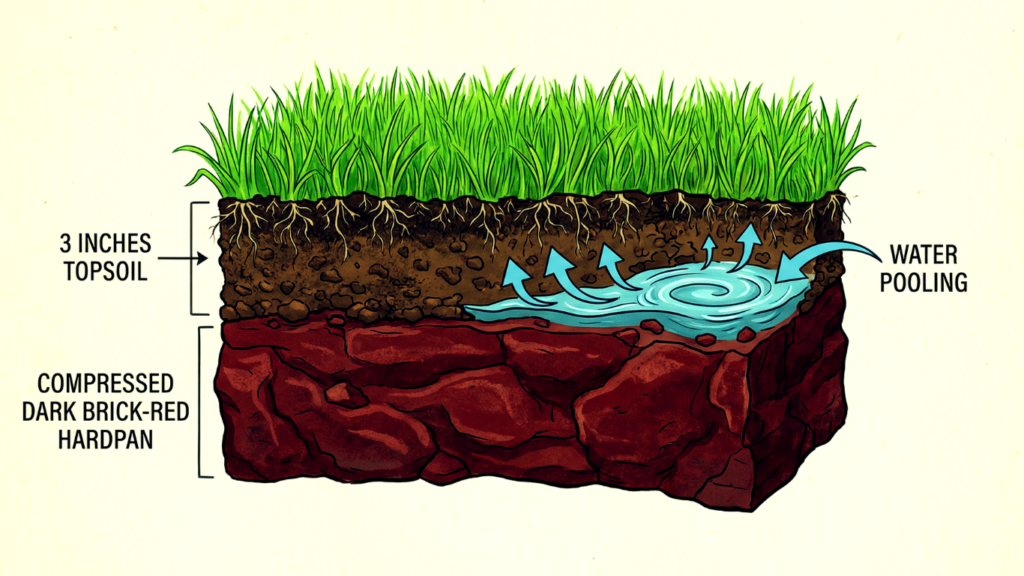
The science is simple. Good soil absorbs water at roughly 2+ inches per hour. North Georgia red clay? Often less than 0.2 inches per hour.
That’s 10x slower than it should be.
Water can’t go down, so it goes sideways. It sheets across your lawn, collects in low spots, and presses against your home’s foundation. Over time, that constant moisture causes cracks, mold, and costly structural repairs.

According to research on North Georgia soil behavior, when water can’t infiltrate downward through the hardpan, it moves horizontally — causing erosion, standing water in low spots, and pooling against home foundations.
Poor drainage isn’t just a lawn issue. It’s a home safety issue.
Not sure if this is your issue? Look for these red flags:
Puddles that sit for hours after moderate rain
Grass that wilts fast even when you water it
Moss or algae spreading in shady spots
Dollar weed popping up (it loves soggy soil)
Tree roots growing sideways instead of downward
Try the screwdriver test: Push a long screwdriver into moist soil. If it stops within 3–4 inches, you’ve got a hardpan layer blocking the way.
The good news: hardpan is beatable, the Drainage damage is real. So, here’s how to attack it layer by layer.
A core aerator pulls small plugs of soil out of the ground. This punches through the compacted layer and opens channels for water, air, and roots.
Bermuda or Zoysia grass: aerate in late spring
Fescue: aerate in early fall
Severely compacted yards: go twice a year
Studies show that lawns with significant compaction lose up to 40% of their drought resistance compared to properly aerated soil. That’s a huge difference in how your yard holds up through Georgia’s brutal summers of drainage damage.
Right after aeration, spread a thin layer of compost across your lawn. It falls into the holes and starts breaking down clay particles from the inside. After 2–3 seasons of consistent top dressing, your soil biology shifts dramatically.

Aeration helps, but it won’t fix everything. If your yard has low spots or poor grading, you need to redirect water before it re-compacts the soil. The best options:
French drains — underground perforated pipes that pull subsurface water away
Dry creek beds — decorative rock channels that handle surface runoff
Catch basins — collect water in low-lying areas
Regrading — reshapes the yard so water flows away from your home naturally
While improving subsurface drainage is vital, managing water runoff from the top down is equally important for large structures.
Experts based on Texas in Perfect Roofing Solution emphasize that — “Proper roof maintenance and drainage are essential to preventing water from pooling near the base and damaging your building’s foundation”
The best approach usually isn’t one single fix but a smart combination of improving how your soil absorbs water, redirecting the water that runs across the surface, and making sure your gutters are actually doing their job.
Daily light watering makes compaction worse. It keeps the top inch soggy while starving deeper roots. Instead, water 1–2 times per week with about 1 inch of water total. Deep, infrequent watering trains roots to push further down — right through those hardpan gaps.
Every year you wait, the hardpan gets worse. Traffic, rainfall, and freeze-thaw cycles pack the soil tighter. Weeds take over. Grass thins out. And eventually, you’re not just looking at a lawn renovation — you’re looking at foundation repairs.
The University of Georgia Extension Service confirms that soil compaction is one of the leading causes of poor turf performance across North Metro Atlanta. This isn’t a fringe problem. It’s the norm here.
A hardpan is a dense, rock-hard layer of compressed soil sitting just 3–10 inches below your lawn. Think of it like an underground concrete slab. Water hits it, stops, and has nowhere to go. So it spreads sideways, pools up, and sits on your surface for hours — or days.
If your lawn stays soggy no matter what you try, the problem is underground — not on the surface. Fertilizer, grass seed, and watering schedules won’t fix a hardpan drainage problem. You have to address the root cause.
If you’re seeing water against your foundation, widespread soggy areas that won’t dry out, or erosion on slopes — it’s time to call in a professional. Maintaining a downhill slope of at least 6 inches over the first 10 feet away from the house is essential to keep water flowing safely. Getting that grade wrong can send a river toward your foundation — or your neighbor’s.
The result? A yard that floods like a swamp after rain, then cracks like a desert two weeks later.


